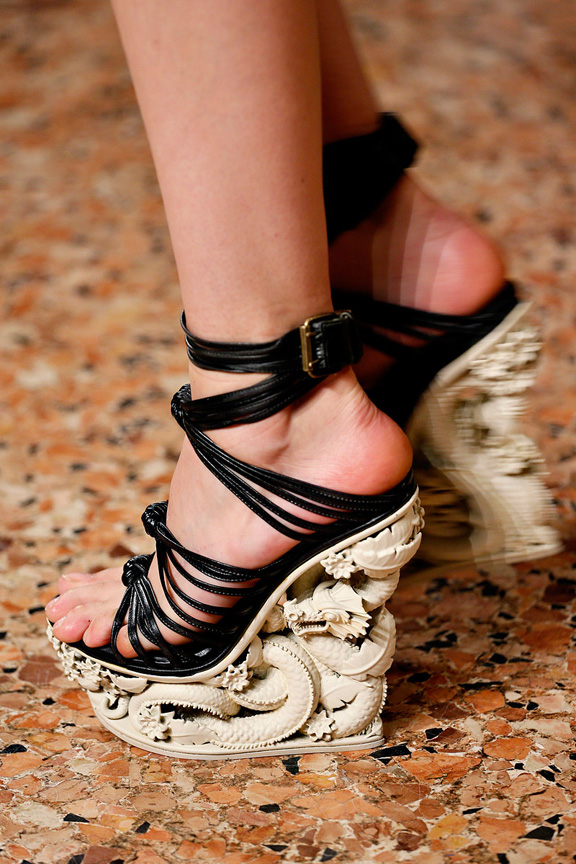
Japanese designers have helped paved the way for innovative fashion. They have been responsible for many trends, techniques, and styles throughout history. These radical designers of past and present have increased the relevance of Japanese fashion week and Japanese style.
 |
Vogue Japan October 2012
Source: http://rockthetrend.com/ |
 |
Yohji Yamamoto Surface Magazine May 2012
Source: http://www.thinkcontra.com/ |
Some of the most noteworthy designers have originated in Japan. Some of them revolutionized textile processes while others recreated the consummate construction of clothing. Some of these designers of change include Tsumori Chisato, Rei Kawakubo, Issey Miyake, Kenzo Takada, Junya Watanabe, Yohji Yamamoto, and Junko Shimada.
It is rare to speak of fashion without mentioning the Japanese designer Rei Kawakubo. Born in Tokyo in 1942, Kawakubo began working with textiles at Asahi Kasei Textile Co. which was famous for its production of synthetic fibers such as spandex, acrylic, and polyester. Kawakubo also worked freelance, specifically in costuming, before later founding the internationally renowned fashion label Comme des Garçons, meaning like the boys. The French name may have derived from the traditionally French androgynous and laissez faire way of dressing. Kawakubo’s first Comme des Garçons boutique was opened in Tokyo in 1975. Kawakubo was a modernist, expressing her taste for art and literature through contemporary practices. She created conceptual fashions that were unconcerned with expectations. Some of her most recognized signatures are minimalism, asymmetry, and unexpectedness. Rei Kawakubo became famous for the Comme des Garçons house and her innovation and unique aesthetic.
 |
Rei Kawakubo
Source: http://www.bandandblog.com/ |
 |
Comme des Garçons
Source: http://blogs.colum.edu/ |
Another prominent and influential Japanese designer is Issey Miyake. Miyake is most famous for his creative and innovative textiles and techniques. Miyake was born in Hiroshima in 1938 and studied at the Tama Art University of Tokyo from 1959 to 1963 as well as the École de la Chambre Syndicale de la Couture Parisienne in 1965. He worked as a design assistant for another famous designer by the name of Guy Laroche who worked specifically with millinery. Miyake also worked for the famous fashion house Givenchy as well as the designer Geoffrey Beene. Miyake opened his first studio in Tokyo in 1970. His work has been featured in exhibitions in the Victoria and Albert Museum in London, the Tokyo Museum of Contemporary Art, the International Design Conference in Colorado, and many more. He has received honors and awards such as an honorary doctorate by the Royal College of Art in London, a Tokyo Creation award, and many others. Some of Miyake’s more celebrated work includes innovative pleating techniques and the utilization of metals as fibers in textiles. His textiles are known to be more withstanding than others, as well as allow for more movement.
 |
Issey Miyake
Source: http://isseymiyake.zxq.net/ |
 |
Issey Miyake Exhibition in Seattle Art Museum
Source: http://www.elle.com/ |
Some other Japanese designers have created namesake houses that are known for being contemporary and extremely relevant in fashion such as Tsumori Chisato and Kenzo Takada. Chisato attended Toyko’s Bunka Fashion College and worked with Issey Miyake in 1977 before beginning her own line in 1990. Some of her signatures include her easily recognizable playful prints. Kenzo, who is also known for his generous use of patterns, made his name by mixing unexpected prints together from pieces he found at flea markets. This technique became synonymous with his name. Some of his awards include the Fashion Editor Club of Japan prize.
 |
Tsumori Chisato
Source: http://www.mystylematterz.com/ |
 |
Tsumori Chisato SS10
Source: http://museforfashion.files.wordpress.com/ |
 |
Kenzo Takada
Source: http://hyypezup.com/ |
 |
Kenzo AW06
Source: http://www.style.com/ |
Junko Shimada is another famous Japanese designer. Shimada attended the Jujino Gajen Dressmaker Institute of Tokyo, but soon after moved to Paris, the fashion capital. Her work experience included the Mafia Design Studio as well as head childrenswear designer of Cacharel. Shimada began designing under her own name in 1981 and was named by press as the most Parisian of Japanese. While most of her famous work was done in the 80’s, especially with her suits, Shimada continues to design today, having her work celebrated on runways and in showrooms.
 |
Junko Shimada
Source: http://www.globalblue.com/ |
 |
Junko Shimada SS10
Source: http://debonairpanda.blogspot.com/ |
Junya Watanabe was the protégé of Comme des Garçons designer Rei Kawakubo. Watanabe was born in Fukushima, Japan in 1961. Like Tsumori Chisato, Junya Watanabe also attended Bunka Fashion College in Toyo, although Watanabe graduated from there in 1984. Watanabe’s specialty was printmaking, much like other Japanese designers we have discussed. Watanabe worked for the Comme des Garçons house under his own name, and now has his own namesake label. His most famous work includes using an eclectic mix of textiles such as organic, synthetic, and his own innovative materials.
 |
Junya Watanabe
Source: http://www.brownsfashion.com/ |
 |
Junya Watanabe AW14
Source: http://www.style.com/ |
Japanese fashion has strongly influential, especially concerning the focus on textiles, techniques, and styles. Famous Japanese designers throughout history have helped create a foothold for influence in fashion around the world.