Friday, July 19, 2013

Parallel Worlds Part 1

                What do comic books and fashion have in common? As it happens, a lot. The vibrant hero-filled pages and the technicolor crush of clothing are generated by the same artistic processes. Often, concepts that seem too exotic or surreal for real life are the very same ones that are most at home in the transcendent and often parallel worlds of fashion and comic books.
Lulu Magazine Editorial
Source: Lulu Magazine, http://forums.thefashionspot.com/
Zatanna from DC Comics
Source: DCComics.com
Emma Frost on the cover of New X Men
Source: http://goodcomics.comicbookresources.com/
September 2007 Issue cover
        Gisele Bündchen, Vanity Fair, September 2007.
Source: http://www.fashionserved.com/
                Color combinations such as color blocking, monochromatic matching, and complimentary, split-complimentary, triad, and analogous color arrangements are part of the well thought-out designs for two dimensional comic heroes and fashion amazons. Color is a universal tool of comic book artists and creative directors that is used to define the characters of make-believe muses who embody our vision of the present and dreams of the future. Their dynamic stories are told through the endless tints and saturations borrowed from the visible color spectrum.
Source: http://www.homeinfostop.com/color-wheel/
                One only has to catch a glimpse of the green catsuit of Poison Ivy to appreciate the planning that went into choosing a color that perfectly complements her red hair, mirrors her dedication to all things chlorophyll, and defines her personal aesthetic. Likewise, designers often have signatures in their oeuvre or in a particular collection, such as the Valentino red (hence Red Valentino), the Gryphon gold, or the Calvin Klein white.
I have thought about doing a Poison Ivy costume, but I just don’t think it’s me.
Poison Ivy
Source: http://www.comicvine.com/
                Comic book characters find definition and tangibility for their style in the costumes and/or clothing they wear just as designers do for their muses. Clark Kent changing into his famous blue and red Superman costume is the equivalent of a model being primped three hours before a runway show. The transformation occurs in which the sketch becomes the character, whether they are a comic book or lookbook heroine.

Manish Arora AW12
Source: http://www.style.com/fashionshows
Romance Was Born SS12
Source: http://frumpytofunky.blogspot.com
Tom Ford SS13
Source: www.chrismoorephoto.co.uk
Lisa Perry Dress
Source: http://meappropriatestyle.com
Jeremy Scott AW11
Source: http://www.style.com/fashionshows

Wednesday, May 15, 2013

Synchronized Souls: Haider Ackermann and Gareth Pugh

          At first glance, the designers Gareth Pugh and Haider Ackermann couldn't be more divergent. Gareth gravitates toward Gothic and futuristic fashions, becoming a favorite of the darker fashion followers, while Haider remains ever true to his Eastern heritage, carving a niche in the effortlessly chic fashion circles. It is by chance that the two designers have created such complementary fashions and converged in their mindset to create some of the strongest, most iconic clothing in present day fashion.
Gareth Pugh AW11

Haider Ackermann SS12

Color

Haider Ackermann sees fashion in living color. He was born in Colombia, trained in Belgium, and is a current citizen of France. Colombia- where the colors are bright and exotic, is reflected in Haider’s color palettes of lapis, turquoise, and amethyst. Belgium’s taste for neutrals has influenced his appreciation for beige, sand, and cider. And because the French are known for having a color sense that considers navy blue and black complimentary, it is understandable that Haider Ackermann would be the one designer to combine such colors as emerald green and burnt orange or baby blue and burlap.
Gareth Pugh sees fashion in black and white and occasionally shades of gray. Where many a designer may tire of the routine colors or the absence of them, Gareth uses it to inspire him in all other faculties of design. His color choice never hinders his ability to develop new ideas based on his same modus operandi.

Process

Haider takes his inspiration from the streets. Literal translations of trend and style come only after Haider has had his pick of color and fabric, but unlike most artists, Haider focuses almost solely on the latter. Silhouette and construction take form in Haider’s sinuous draping and layering. Design ease plays a large part in Haider’s creations, the fit and lay of the fabric on the body of primary importance. Haider seeks to compliment the architecture of the body with his clothes.
Gareth’s inspiration is derived from sources ranging from cockfighting and flamenco to Aztec warriors and the ever-present Japanese influence. Light, birds, and spaceships will always be secondary to his more dominant source of inspiration: the Amazonian woman. The male feminist transforms models into indestructible matriarchs as they take the catwalk, featuring dramatic make-up and face-obscuring headdresses. Gareth’s clothes embody his ideal woman with long, articulate, purposeful cuts.

Fusion

Their palettes, textiles, and techniques may differ, but the synchronized souls of both Haider Ackermann and Gareth Pugh keep them on the same artistic platform. The unexpected romanticism in these two designers, and their emphasis on designing for a strong woman, has helped them converge in their Fall 2013 shows. Gareth has begun to explore softer volumes and add more warmth to his collections. Meanwhile, Haider has stripped his clothes of some of their color and explored more of the tailoring, of which he is so capable. Both designers continue to observe the boundaries and then push them.
Gareth Pugh AW13
Haider Ackermann AW13
All Photo Credits: http://www.style.com/

Thursday, March 14, 2013

Who Is Vika?


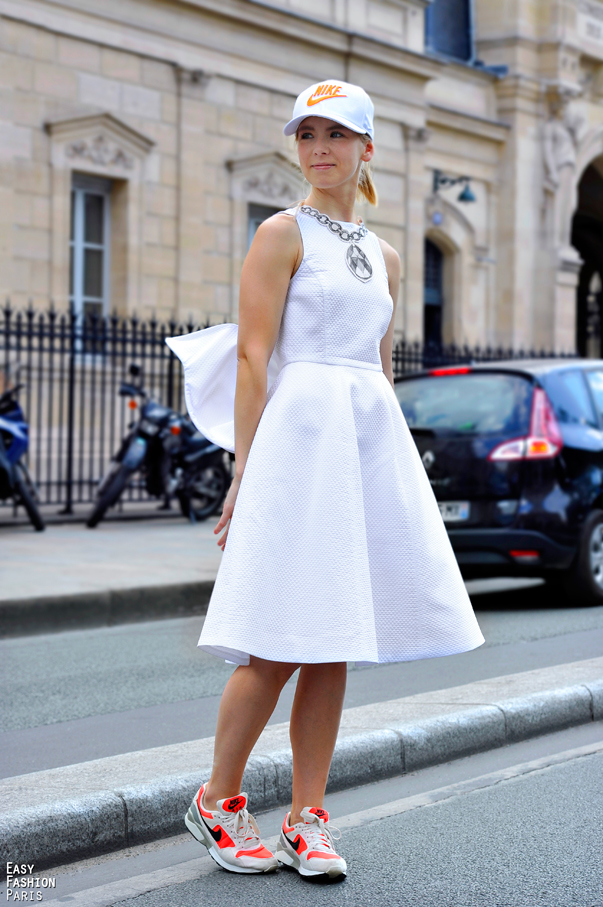
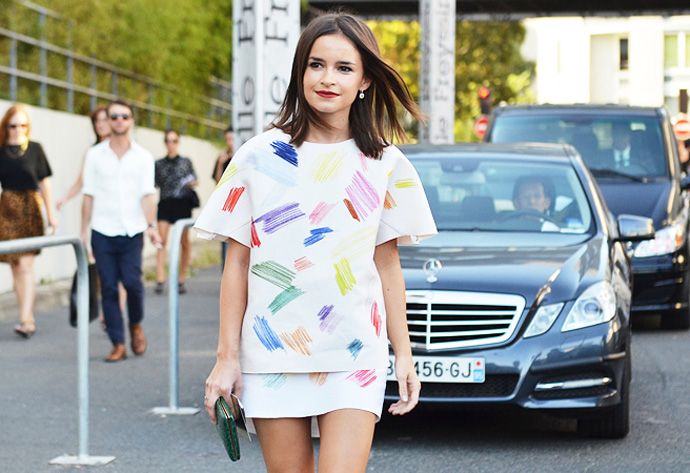
Vika Gazinskaya is a designer, a streetstyle star, and a fashion chameleon. Whether she’s mesmerizing the fashion week photographers or hanging with her best friend and fellow Russian, Miroslava Duma, Vika can only be described as spectacular. She mixes high and low, color blocks like a female Haider Ackermann, and changes her hairstyles more than Lady Gaga.
Vika Gazinskaya is who you would get if you mixed Anna Wintour with Tegan and Sara. She is casual while wearing the finest of couture. She is ironic (did she really pair that Led Zeppelin tee shirt with that jungle print skirt suit?). She is enchanting. Example: the cardinal print halter dress she designed herself. She is traditional and among the most innovative of designers. Her digital prints include glittering jewelry screen printed onto garments.
Source: http://www.all-theprettybirds.com/2012/12/vika-gazinskaya-on-looking-forward-to.html
Source: http://wearinla.com/2012/10/03/miroslava-duma-international-style-icon/aba_5141-vika-gazinskaya-by-hanneli-mustaparta/
hebergeur image
Source: http://easyfashion.blogspot.com/2012/09/vika-gazinskaia-fw-paris.html
Source: Tommy Ton for Style.com
Vika’s designers are inspired by a holistic approach to life and beauty. With no single concept in mind, Vika develops each collection as an extension and visualization of her aesthetic. These include clean lines, slightly exaggerated but complimentary silhouettes, and an abundance of digital prints. Vika’s influential presence at New York and Paris Fashion Weeks has coincided with the popular reception of her fashion line. Her clothes have been famously worn by Miroslava Duma, Anya Ziourova, and Hanneli Mustaparta.
Source: http://www.poisepolish.com/2011/10/russian-girl-crush-vika-gazinskaya.html
Source: http://www.all-theprettybirds.com/2012/12/vika-gazinskaya-on-looking-forward-to.html
Source: http://vanessajackman.blogspot.com/2012/01/paris-fashion-week-ss-2012hanneli_12.html
Vika Gazinskaya’s designers are mentioned in the same sentences as the likes of Viktor & Rolf and Mary Katrantzou. Her SS13 designs are currently featured in the windows of Colette, a store in Paris that is just this year celebrating its 16th anniversary. These designs are also now available through Net-A-Porter and Moda Operandi, and future seasons will continue to be sold through Net-a-Porter. Vika’s expansion into the European market as well as the Middle Eastern market is important for her namesake brand to grow, since Russia does not have a concentrated or established fashion industry. Vika’s designers are also available in boutiques in Dubai, Kuwait, Hong Kong, London, Milan, Seoul, New York City, and Charlotte, North Carolina.
Vika Gazinskaya SS13
Vika Gazinskaya SS12
Source: http://vikagazinskaya.com/
So who is Vika Gazinskaya, you ask? She’s the blonde with the bangs and the enchanting blue eyes. She’s the one in the asymmetrical dresses with scarves wrapped around her head. She’s one who can pull off both an undercut and a chef’s coat. She's the one who's designs the fashions everyone is wearing to the shows. She’s the one you’ll remember when fashion week is over.

Tuesday, March 12, 2013

Anonymous Costume Design

The first resource to jump to when trying to find out the designer of your favorite character’s clothing pieces is the costume designer. Is there an interview or video clip where they might mention said mysterious designer? If not, do not fear, there may be fashion credits at the end of the film or online. Still no luck? You may have to figure it out yourself.
What kind of piece is it? What stands out the most? Who was it made for? Was it within the character’s budget? Here are some examples of educated guesses of designer movie garments.
Source: http://www.imdb.com/media/rm2910492928/tt0263757
We already know from the movie Uptown Girls that the character had a lot of money to spend on clothing, so we can assume that this dress is an expensive designer item. Then we have to narrow it down to designers that this character would most likely wear. This cancels out any Armani, Versace, or Balmain. These designers do not fit that character’s profile. Next, we look at the style. What designer would be able to sell “cute” dresses with doll-like embroidery to a target market with enough disposable income to afford it? My first guess is Moschino.
Source: http://www.kinopoisk.ru/film/6387/
Next we have this lovely sequin embellished dress with flower appliques from the same movie, Uptown Girls. Assuming this dress wasn't custom made for the film by the costume designer, we can think of several options for possible designers. Our first clues are the colors. A delicate palette of natural hues indicates a designer with a more girly clientele. Secondly, we have the embellishments. This dress is clearly not made for grocery shopping or a day at the office. With this, we can select some designers who would likely cater to an optimistic consumer with a weakness for pretty things. The conclusion: Blumarine.
Jennifer Lawrence The Hunger Games Catching Fire
Source: http://www.disneydreaming.com/2013/03/07/jennifer-lawrence-the-hunger-games-catching-fire-movie-poster/
If we didn't already know the designer of this wedding dress in Hunger Games: Catching Fire, we could likely derive clues from the picture. First of all, the dress is incredibly exotic and otherworldly. Maybe the designer is not well known and has a smaller client base. Also, learning how to construct wedding gown fabrics takes a lot of practice, so we can assume the designer has done other gowns similar in style. And if we didn't already know it, we can figure out that the designer is Tex Saverio.
thirteengoing
Source: http://www.spfw.net/blog/?p=125
The designer of this dress in 13 Going on 30 obviously has a thirst for color. Also, we know they do not shy away from a body-con silhouette, even though it may call for a specific target market. The hemline is high and the neck is low. Who would be our most likely candidate for designing this dress? None other than Versace.
Figuring out who made a garment in a movie can be a lot of fun and give you a more in-depth look into a character, but the process can also help you figure out any piece of clothing, ever. Once you know about the designers: their aesthetics, the color palettes they gravitate toward, their target market, and their style; you can figure out who designed a piece without ever having to pour over mountains of runway shows. Unless you want to, of course. ;)